
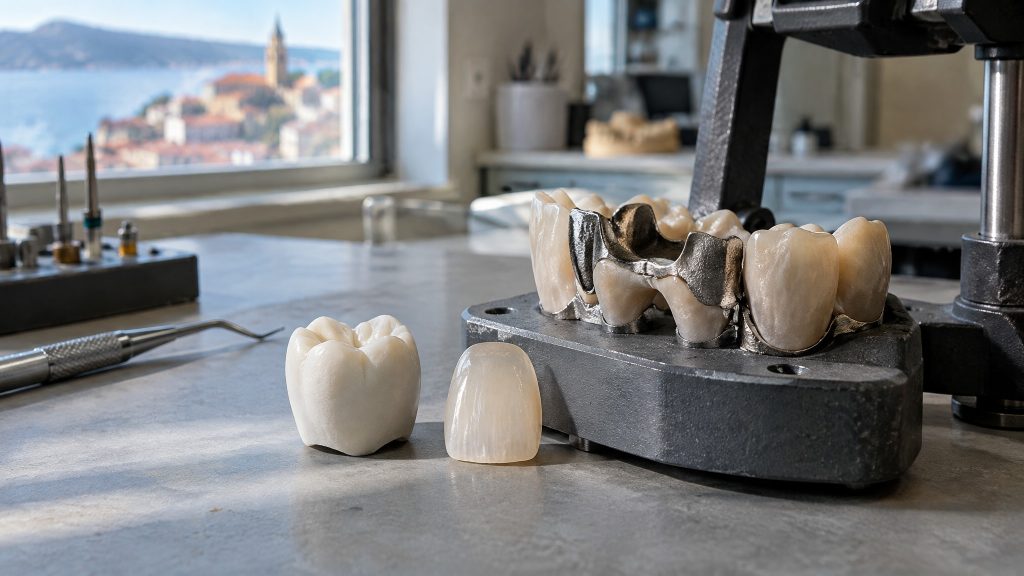
Anyone in Split looking for the price of ceramic crowns quickly notices that offers often mix different materials under the same name. Therefore, the price per tooth is not a single figure. It depends on the material, the condition of the tooth beneath the crown, and the amount of laboratory work involved.
Key Messages
- The price of a crown per tooth primarily depends on the material: zirconia is common for posterior teeth, porcelain and lithium disilicate ceramics for anterior teeth, and metal-ceramic is often a more affordable option.
- The price per tooth typically includes an examination, preparation, temporary and final crown, and cementation. A core build-up or root canal treatment will alter the total amount when necessary.
- A crown on an implant combines three components (implant, abutment, and crown), while a dental bridge is calculated by units and abutments.
- A clinic’s in-house laboratory means direct communication between the dentist and technician regarding shade and fit, but it does not automatically imply a lower price.
- Before starting treatment, written warranty terms should be requested, and the material and estimated price are determined only after an examination.
Clinic Burow has been operating in Split for over 30 years, integrating dentistry, prosthetics, and implantology under one roof, with specialist doctors. Below, materials are separated, what the price includes is explained, and the final amount for your tooth is determined during the examination.
Price of Ceramic Crowns in Split by Material: Zirconia vs. Ceramics
The price per tooth primarily depends on the material. When a patient inquires about the cost of a dental crown, each material should be considered as a separate item with its own price, as metal-free zirconia, porcelain and lithium disilicate ceramics, and metal-ceramic differ in strength, appearance, and manufacturing complexity.
| Material | Application Area | Strength | Aesthetics | What Influences the Price Per Tooth |
|---|---|---|---|---|
| Metal-Free Zirconia | Posterior teeth, bridges, heavy load | Very high | Good to very good | Zirconia block, digital design, processing, and coloring |
| Porcelain and Lithium Disilicate Ceramics | Anterior teeth, visible areas | Moderate, more susceptible to fracture | Most natural appearance | Layering, individual shade, complexity of shape |
| Metal-Ceramic | Posterior teeth, bridges, where aesthetics are not critical | High | Satisfactory, metal margin may become visible | Metal core and ceramic layer |
The exact price per tooth for each of these materials is provided to the patient in the treatment plan, according to the clinic’s valid price list for 2026.
The price per tooth, according to the price list, typically includes an examination, tooth preparation, a temporary and final crown, and cementation. A core build-up or root canal treatment is not always necessary, but when it is, it changes the total amount. Therefore, two crowns of the same material may ultimately have different costs.
Price of Metal-Free Zirconia Crowns
Zirconia is a metal-free material primarily chosen for posterior teeth because it best withstands strong chewing forces. Patients comparing zirconia crowns (whose prices are often listed without explanation in offers) should ask if the amount includes individual color customization, not just a ready-made material block.
Without a metal core, there is no dark margin along the gum line. This is also important for individuals with sensitive gums.
Porcelain Crowns in Split: The Choice for Anterior Teeth
Porcelain crowns in Split are most commonly made for anterior teeth, where aesthetics are crucial, and the same applies to lithium disilicate ceramics. Light passes through ceramic similarly to natural enamel, so the crown does not appear foreign next to adjacent teeth.
The price here depends more on complexity than on the material itself: the more intricate the shade and shape of the tooth, the more laboratory work is involved. Ceramic is also less resistant to fracture than zirconia, which is why we do not recommend it for everyone.
Metal-Ceramic Crowns: A Strong and Often More Affordable Option
Metal-ceramic crowns have a metal core covered with a layer of ceramic. They are strong and often more affordable than metal-free solutions, making them a reasonable option for posterior teeth when budget is an important factor.
They also have a limitation. As gums recede over time, the metal margin can become visible as a dark line, which is usually unacceptable for anterior teeth.
Materials and Durability: What Determines How Long a Crown Lasts
The durability of a crown depends on the material, tooth position, and the load it is exposed to. A cheaper crown that needs more frequent replacement is not necessarily more cost-effective over time, as each replacement means new preparation, new material, and additional appointments. Therefore, the clinic does not promise a specific number of years but discusses with you the factors that are decisive in your case.
Strength, Fracture, and Aesthetics Over Time
Metal-free zirconia better withstands strong chewing forces, making it a common choice for molars. Ceramic is more aesthetic but more susceptible to edge chipping, especially if the tooth is under significant pressure.
Metal-ceramic maintains its strength but may lose its aesthetic advantage over time due to gum recession. Aesthetics, therefore, change not only due to the material but also due to the condition of the tissues around the tooth.
The crown that looks best on the first day is not necessarily the one that will look best after several years.
Habits and Hygiene That Extend Crown Lifespan
You can influence some factors yourself. Teeth grinding and clenching (bruxism) are the most common reasons for ceramic fracture, so your dentist may suggest a night guard if signs of excessive load are observed.
Also, pay attention to the hygiene of the crown margins. If plaque accumulates along the margin, caries can develop under the crown, affecting even the highest quality material. Regular check-ups allow minor damage to be detected before it requires intervention.
The Role of an In-House Laboratory in Crown Quality and Price
Clinic Burow has its own dental laboratory, which is the main difference compared to clinics that order crowns externally. The crown is not sent to an unknown address; instead, it is created in the same facility where you were examined, under the supervision of people familiar with your case.
Direct Communication Between Dentist and Dental Technician
When the dentist and dental technician are in the same building, shade, shape, and fit are not conveyed solely by a written order. The technician can come to examine the tooth, and the dentist can check the crown during fabrication, which reduces misunderstandings that can easily arise with external laboratories.
Shade, Shape, and Fit Under Control
In practice, the process looks like this: the dentist takes an impression and records the shade of adjacent teeth, the technician fabricates the crown, and during the try-in, both ensure it fits. If the margin, shape, or color needs correction, the adjustment is performed within the same clinic, without sending the work back and waiting.
This is crucial for anterior teeth, as even a small difference in shade is immediately noticeable. The clinic does not make general claims about fabrication speed in days, as it depends on the complexity of the case.
What an In-House Laboratory Means for Price, and What It Doesn’t
The advantage of an in-house laboratory is quality control and responsibility for the entire fabrication chain, from impression to cementation. This does not automatically mean a lower price, so do not expect a crown from such a laboratory to necessarily be cheaper than one from another source.
Therefore, compare offers based on three combined factors: price, quality of fabrication, and warranty terms. The lowest amount without specified material and written terms does not say much.
Implant-Supported Crowns and Dental Bridges: How the Price is Formed
When a tooth is missing, a crown can be supported by an implant or as part of a bridge. In both cases, the total amount results from summing multiple items, not a single number.
Price of an Implant-Supported Crown and Its Components
An implant-supported crown consists of three parts: the implant in the bone, the abutment, and the crown itself. Therefore, the price of an implant-supported crown cannot be read as a single item but as the sum of three separate parts, with potential bone preparation procedures if needed.
The part related to the implant itself is explained in more detail in the guide on the price of dental implants in Split. The crown material (zirconia or ceramic) is chosen according to the same rules as for a natural tooth.
Dental Bridge in Split: Price Per Unit and Number of Abutments
When you inquire about the price of a dental bridge in Split, it is most often presented per unit, but the actual amount also depends on the abutments. A bridge is calculated by units, i.e., by the teeth it replaces, and by the abutments that support it.
If the bridge relies on natural teeth, those teeth must be prepared and shaped for crowns. If it relies on implants, tooth preparation is omitted, but implants are added to the cost. The more teeth a bridge replaces, the higher the total amount.
A bridge is not a solution for every situation, as it depends on the health of adjacent teeth. This is determined by an examination, not the price list.
Crown Fabrication Process: From Examination to Cementation
The price covers several phases, so it is useful to know what happens in each. The number of appointments depends on the complexity of the case and is agreed upon in the treatment plan, which particularly helps patients from Germany, Austria, and Switzerland who plan their visit in advance.
Examination, 3D Diagnostics, and Tooth Preparation
The first step is an examination, and when necessary, 3D diagnostics to assess the condition of the root and bone. Based on the findings, the dentist evaluates whether the tooth needs treatment, a core build-up, or can be prepared immediately for a crown.
Tooth preparation follows, then an impression from which the laboratory fabricates the crown.
Temporary Crown, Try-in, and Final Cementation
While the final crown is being made, a temporary crown protects the tooth, so you do not remain with a prepared tooth. During the try-in, the fit, shape, and shade are checked, and if necessary, the crown is adjusted in the laboratory.
Then, the bite is checked, as an overly high crown can stress the tooth and jaw. Only when the bite is balanced is the crown permanently cemented.
Quality Guarantee: What to Check Before Deciding
Before starting treatment, the patient should receive the warranty terms in writing. The clinic operates according to German standards as a framework for work, not as a formal certificate, so reliability is assessed by what is written and signed.
Written Warranty Terms and Patient Obligations
Check what the warranty covers: material, fabrication, and fit of the crown. Also ask what happens if the crown breaks or loosens and who bears the cost of repair.
The warranty also includes obligations for the patient, most commonly regular check-ups and proper hygiene. If these are not met, the warranty may be limited. The duration and details of the terms for your case are confirmed by the clinic in the document you receive with your treatment plan.
Scheduling an Examination and Price List for Your Case
The material and estimated price for a specific tooth are determined during the examination, as only then can the dentist assess the condition of the tooth, gums, and bite. A quick estimate without an examination cannot replace a treatment plan, and this text does not attempt to do so.
You can schedule an appointment via online booking or by direct contact with the clinic. A broader overview of solutions can be found on the page about the clinic’s prosthetic services.
If you are coming from Germany, Austria, or Switzerland, it is best to arrange the treatment plan and appointments before your trip. This way, you know in advance what steps to expect, how long you will most likely need to stay, and what the plan includes.
Frequently Asked Questions
Why do crown prices vary so much between offers?
The material, complexity of fabrication, and scope of service differ. Some offers list only the crown, while others include examination, preparation, a temporary crown, and cementation. Therefore, compare offers by material, coverage, and warranty terms.
Is zirconia a better choice than ceramic?
Neither is better in every case. Zirconia is stronger and common for posterior teeth, while porcelain or lithium disilicate ceramics are chosen for anterior teeth due to their appearance. The dentist decides based on tooth position and load.
Is a crown from an in-house laboratory cheaper?
Not necessarily. The advantage of an in-house laboratory is quality control and direct communication between the dentist and technician, not automatically a lower price.
Can I arrange a treatment plan before arriving from Germany, Austria, or Switzerland?
Yes, it is recommended to arrange the treatment plan and appointments before traveling. The number of visits depends on the complexity of the case and is determined in the treatment plan.
What should I receive in writing before starting treatment?
Written warranty terms, stating what is covered (material, fabrication, fit) and patient obligations, such as regular check-ups and hygiene.